
Sandy Lintel had been curate at St Faithful’s long enough to know that “I thought we might try something interactive” should be approached cautiously.
Nevertheless, she had prepared carefully.
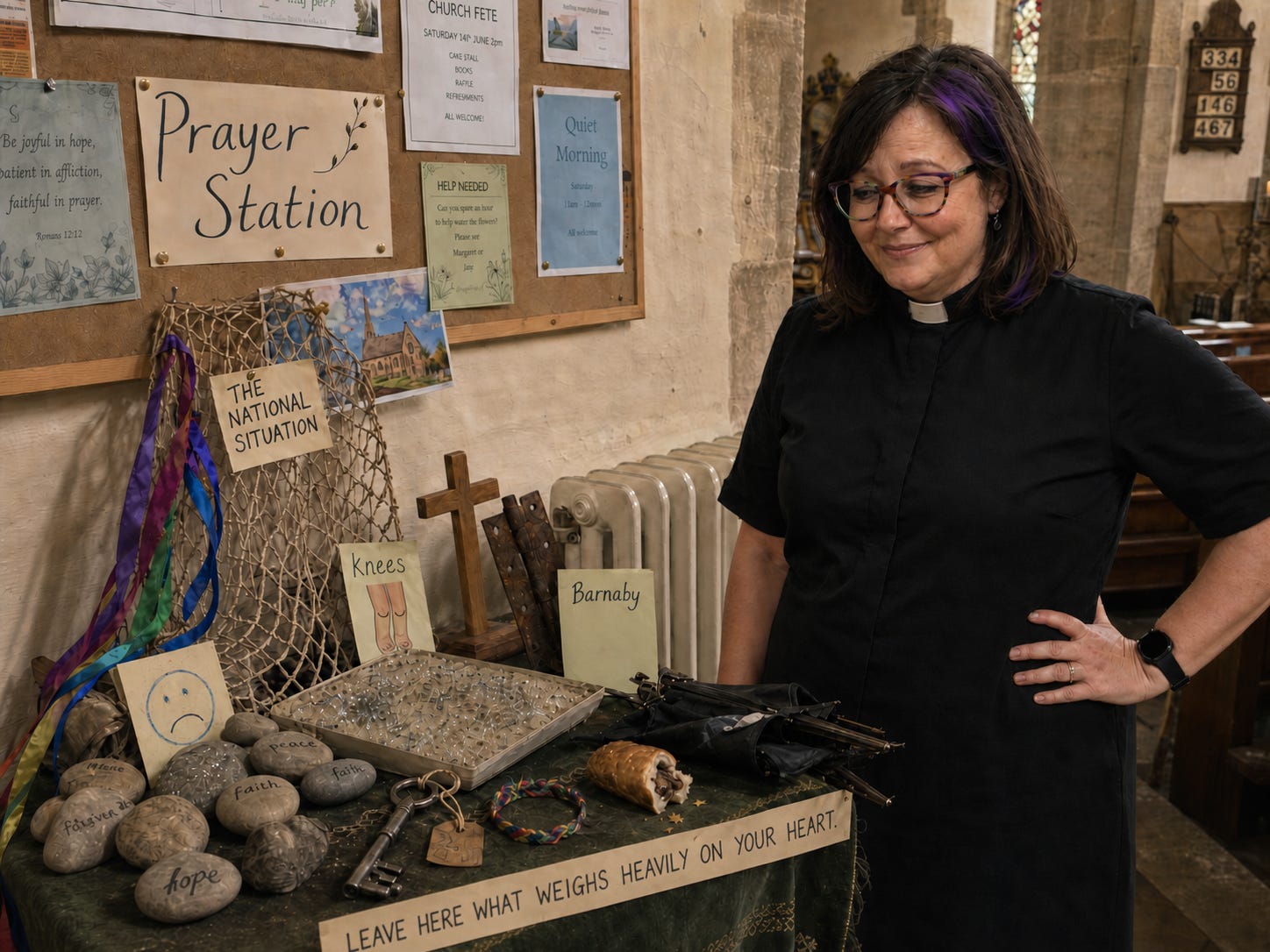
At the back of church, beneath the noticeboard and just left of the radiator that only worked when no one needed it, Sandy had arranged a prayer station: smooth stones, ribbons, a small wooden cross, a tray of sand, and cards printed with gentle lettering:
LEAVE HERE WHAT WEIGHS HEAVILY ON YOUR HEART.
Sandy stood back, pleased. It looked prayerful. Then Dobbs arrived.
“What’s this?”
“A prayer station.”
Dobbs examined it as though it were an unattended bag.
“Is there a timetable?”
“No.”
“Then station may be overstating it.”
Sandy breathed in through her nose.
“People will see it as they arrive,” she said, “and leave behind something that feels heavy.”
Dobbs looked at the stones.
“Those are already heavy.”
“Yes. Symbolically.”
“Ah,” said Dobbs, in the tone of a man who had identified the problem.
By ten o’clock, the church was full enough for Sandy to feel hopeful and empty enough for Judith to describe attendance later as “encouraging, under the circumstances.” Tim was away at a deanery meeting on missional imagination.
So Sandy was presiding.
She welcomed everyone. She explained the prayer station. She used words like “burden”, “release”, and “placing things into God’s hands”. She avoided “liminal”, which no-one understood anyway.
The first person to move was June Mosse, who returned carrying a plastic tub.
“I’ve brought glitter,” June whispered.
“Why?”
“To make it more hopeful.”
Before Sandy could answer, June had added a silver layer to the sand tray, so that the wilderness now resembled a nursery craft incident.
Next came Perry Wainwright. He stood for a long time with a card in his hand. Perhaps beneath the tweed and the chronic belief that church life was improved by subcommittees, there was a man longing to lay something down.
Perry wrote carefully, pinned the card to the prayer net, and returned to his pew.
Sandy glanced at it later.
THE NATIONAL SITUATION.
It had been attached with three drawing pins and a certain assertive violence.
Then Alan Dobbs approached. He did not so much pray as audit. He lifted one stone, weighed it, replaced it somewhere marginally more correct, and reached into his pocket. Out came a key on a piece of string.
“That,” he murmured, placing it beside the cross, “has been troubling me for some time.”
“I’ve no idea what it opens.”
“Still,” said Sandy. “Perhaps that’s a kind of prayer.”
“It might be the boiler cupboard.”
During the second hymn, the children came up. The first placed a sad face beside the stones. The second left a friendship bracelet, which broke Sandy’s heart. The third deposited half a sausage roll.
His mother hissed, “James!”
“It was weighing heavy,” said James.
“It was your snack.”
“Its gone cold.”
Sandy chose not to intervene.
The station had begun to change character. What had started as contemplative space now resembled a vestry drawer after a power cut. There was Perry’s national situation. Dobbs’s possible boiler key. A broken umbrella. Someone had written “knees” on a card. Someone else had written “Barnaby”, which might have been a person or a pet.
Then Horse Palmer came up.
Horse never approached an object without considering whether it needed moving, fixing, or leaning on. Kevin Keen, from the pew behind, watched with the expression of a man silently screaming stop.
Horse produced a small metal hinge. Rusted, heavy, and faintly oily.
He put it beside the cross.
“What’s that, Horace?” Sandy asked softly.
“Gate hinge.”
“And you’re leaving it with God?”
Horse considered this.
“Well,” he said, “God made iron.”
It was at that point that Lionel, watching from the organ bench with increasing despair, began the gradual hymn at a tempo suggesting he’d like to leave as early as possible today.
Sandy preached after the Gospel. She had prepared a careful homily about surrender, silence, and contemplative openness. It had Julian of Norwich in it and one small joke about rotas.
But as she stood in the pulpit and looked at the prayer station — glittering, unstable, smelling faintly of sausage roll — she knew the sermon was no longer true enough.
So she closed her notes.
Judith looked up sharply. Dobbs appeared alarmed.
“I was going to talk,” Sandy said, “about laying down our burdens in a calm, beautiful, well-ordered way.”
She looked at the back of church.
“But apparently we have brought God a broken umbrella, a mysterious key, the national situation, two knees, Barnaby, half a sausage roll, and a gate hinge.”
A ripple of laughter moved through the pews.
“And perhaps that is better. Because most of us do not come to God with our lives arranged like a retreat brochure. We come cluttered. We come with pockets full of things we meant to sort out. We come with anxieties we cannot name, snacks we cannot finish, and bits of old iron from gates that will not hang straight.”
Horse nodded, deeply.
“And God does not wait for us to make it elegant. God receives what we bring. Even if what we bring is ridiculous. Especially then, perhaps.”
For a moment, St Faithful’s was quiet.
Then James whispered, “Can I have my sausage roll back?”
And Sandy, to her own surprise, laughed first.
After the service, Dobbs retrieved the key, having remembered it opened the old vestry cupboard. Perry said the national situation looked slightly better pinned up. June announced that she was more than satisfied with the glitter effect.
Horse reclaimed the hinge.
“I thought you were leaving that with God,” said Kevin.
“I did,” said Horse. “He reminded me where I put the screws.”
Judith came up beside Sandy.
“Well,” she said, “that was nearly a disaster.”
“Yes,” said Sandy.
“In a good way.”
At the back of church, silver glitter shone in the sand like grace among the crumbs.
Later, Dobbs tried to hoover it up and blocked the machine.
________________________________________
Enjoyed your visit to Havnot?
St Faithful’s is fictional. The affection is real. The meetings, regrettably, are plausible.
If you would like more parish life, more Dobbs, more Judith, more theology, more books, more chaos, or a mug that quietly suggests you have survived a PCC meeting, everything begins here:
https://tinyurl.com/4k9jtpbe
That link will take you to Canon Tom’s books, e-books, audiobook, merchandise and Substack, all gathered together in one slightly alarming but useful place.
Print books are also available — in person only — from St Faith’s Charity Shop, 4 North Street, Havant.
A note on AI: ChatGPT (we call him Artie Fischal) is often deployed to add editorial and image value to these posts. The drafting and publishing responsibility is entirely human.

I'm so glad Sandy decided to close her sermon notes - what followed was so much better!
The glitter, oh the glitter! Yet even that fit in. What a beautiful reflection on the messiness of our prayers and the fact that we can bring it all to God… no matter how messy (or glittery 😉) it is. Thanks for being open to the Spirit, Sandy!!