THE DOLPHIN INTERVENTION
A story from the fictional parish of St Faithful's, Havnot

Note: This story is a sequel to ‘The Romance Department’ and ‘The Peace Camp in Pew Four’. I suggest you read them first, in that order.
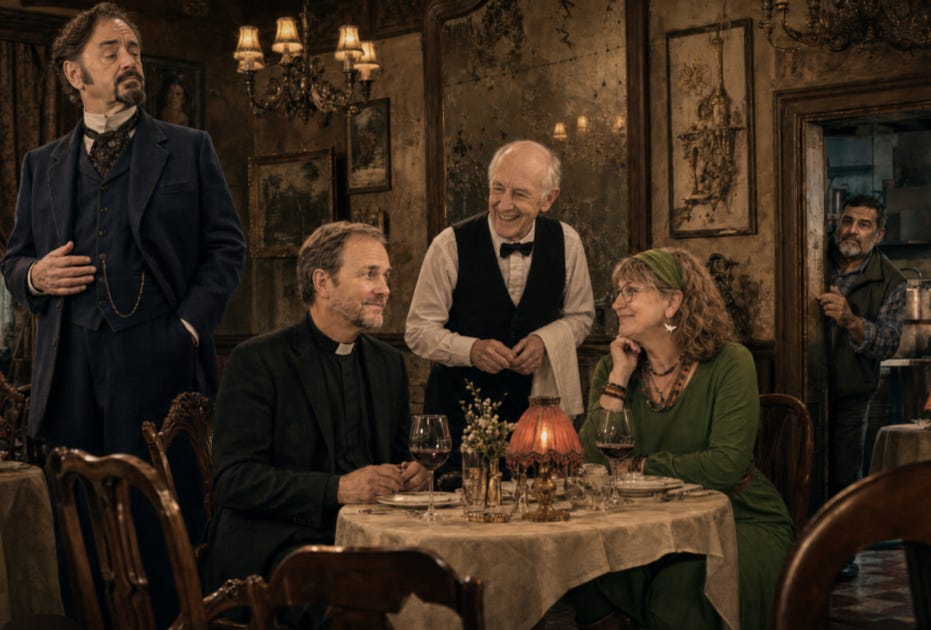
The Dolphin Hotel had once been important, and wanted everyone to know it. It had been a coaching inn in the days when Havnot sat grandly on the turnpike road between Portsmouth and Arundel, and men in capes had arrived in the rain demanding horses, ale, and rooms with less highwayman in them. Fragments of dignity remained: a cracked eighteenth-century mirror, a fireplace large enough to roast a Dissenter, and a staircase which complained in three historical time periods.
Unfortunately, the present had happened.
The Dolphin now smelt faintly of gravy, brass polish, and curtains which had seen things. Its rooms were too large for intimacy and too small for parties. The restaurant, labelled À LA CARTE outside, had four tables, three chandeliers, and the emotional atmosphere of a pension review.
This made it perfect.
No one from St Faithful’s came to The Dolphin unless attending a wake, avoiding one, or collecting an elderly relative who found the Little John “a bit noisy”. Tim and Sybil could therefore meet privately.
Tim arrived ten minutes early; anxiety had punctuality as a side effect. He checked his reflection in the cracked mirror and looked, he thought, like a vicar dressed as a man going to dinner.
Sybil arrived exactly on time, in a green dress, boots, and earrings suggesting peace but not surrender. Tim tried not to stare, failed inwardly, and concluded that Sybil had the alarming quality of looking entirely herself and becoming more attractive by the second. He wondered what on earth she saw in him, a mournful widower, with nothing but a church stipend and a draughty vicarage to offer.
“You came,” said Tim, barely concealing his surprise.
“I said I would.”
“Yes. Of course. I didn’t mean—”
“I know what you meant” said Sybil, but kindly.
This was already going well, in the sense that Tim had not yet apologised to furniture.
Gregory Sandlelace, owner, manager, maître d’ and complaints department, swept towards them.
“Vicar! Madam! Welcome to The Dolphin’s à la carte Restaurant.”
He pronounced “restaurant” as if applying for funding.
“Mr Sandlelace,” said Tim.
“Gregory, please. We are informal here. Within limits. The specials are on the board, though I recommend not touching the board itself. The chalk has opinions.
“I may say that I’m hopeful that Michelin will soon happen upon our humble restaurant and offer a favourable review.”
Tim found this a highly unlikely scenario, on multiple counts.
“And what an honour it is,” continued Gregory while doing a fair impression of Jane Austen’s Mr Collins, “to have the clergy dining with us. Standards are rising, Vicar. Indeed, I have taken on additional staff today to cope with demand.”
Tim glanced round the empty room.
“Demand?”
“Anticipated demand,” said Gregory.
He showed them to a table beneath the portrait of a naval officer who looked as if he had ordered soup in 1783 and was still waiting.
Tim sat opposite Sybil.
For a moment, they were quiet.
“So,” said Sybil.
“So,” said Tim.
“Christian pacifism.”
“Yes.”
“Not much of a romantic opener, is it?” said Sybil, with a nervous laugh.
“I thought perhaps we might warm up first,” suggested Tim.
“With what?”
“Bread rolls?”
Sybil smiled. It helped.
Then a shadow fell across the table.
“What would Sir and Madam care to order?”
Tim looked up.
Alan Dobbs stood beside them in a black waiter’s waistcoat, bow tie, and the expression of a man who had infiltrated enemy territory. A white towel over his arm gave him dignity he had not earned.
“Dobbs?”
“Good evening, Vicar.”
“What are you doing here?”
“Waiting, sir.”
“Yes, I can see that, but why?”
“I answered an advertisement.”
Sybil leaned back. “For espionage?”
“For part-time hospitality support,” said Dobbs, with the offended dignity of a man caught with his hand in the biscuit tin.
From the kitchen came a crash.
Dobbs froze.
A large head appeared round the door.
“All right,” called Horse. “Only plates.”
Gregory, still hovering nearby, closed his eyes. “That is our new kitchen assistant.”
“Horse?” said Tim.
Horse disappeared.
Sybil looked at Tim. Tim looked at Sybil.
“So much for privacy,” she said, with a sunny smile.
“I’m so sorry.”
“Don’t be. This is much funnier.”
Dobbs took out a pad.
“Starters?”
Tim, recovering slightly, and with an innate sense of what Dobbs could and couldn’t spell, decided to retaliate.
“I’ll have the bruschetta.”
Dobbs frowned. “Brush what?”
“Bruschetta.”
Dobbs wrote carefully. “Brush shelter.”
Sybil said, “I’ll have the vichyssoise.”
Dobbs stared at her.
“Is that fish?”
“Cold soup.”
“On purpose?”
“Yes.”
Dobbs wrote something which appeared to be “Vicar’s oysters”.
“For mains,” said Tim, “perhaps the coq au vin.”
Dobbs looked pained.
“Cock of van?”
“Coq au vin.”
Dobbs stared at his pad as if French were a personal insult.
“And Madam?”
“The ratatouille.”
Dobbs brightened. “I’ve heard of that. Cartoon rat.”
“Vegetables,” whispered Sybil conspiratorially.
“Petite pois with champignons” said Tim.
Dobbs dropped his pencil.
Another crash came from the kitchen. “No problem. That one was cracked already,” said Horse.
Dobbs retreated with the solemnity of a diplomat withdrawing from failed peace talks.
Tim and Sybil lasted four seconds before laughing.
“There goes our respectable evening,” said Tim.
“Respectable evenings are over-valued.”
“I was hoping not to be observed by parishioners.”
“You were hoping to impress me.”
Silence settled again, gentler this time.
Sybil glanced at his hand. “Can I ask? You still wear your ring.”
Tim looked down. His thumb moved to the gold band before he could stop it.
“Yes.”
“Sarah?”
He nodded.
“I liked her. She was good people.”
“Thank you,” said Tim. “She was amazing. She even got on with my mother.”
“Five years?”
“Five years last March.”
“I’m sorry.”
“Thank you.”
There was no fuss in her voice. No sentimental upholstery. Just room.
“I didn’t take it off,” he said, still rotating the ring between his thumb and forefinger. “At first because I couldn’t. Then because I didn’t want to. Then because I wasn’t sure what it would mean if I did.”
“And now?”
“I still don’t know.”
Sybil nodded. “That’s honest.”
“It feels cowardly.”
“Not everything unresolved is cowardice, Tim.”
He looked at her. She had used his name. Not Vicar. Tim.
“That may be the kindest thing anyone has said to me.”
“Don’t get used to it.”
He laughed softly.
“What about you?” he asked.
“What about me?”
“You said the sermon reminded you of Greenham.”
Her face shifted. Not closed, exactly. Fortified.
“I gave years to that life. Greenham. CND. Marches. Draughty halls. Leaflets smelling of hot dust and the collapse of civilisation. By the Millennium, we honestly thought history had turned. Berlin Wall down. Soviet Union gone. The world might actually become sane.”
“And now?”
“Now we have better phones and worse imaginations.”
Tim said nothing. A half smile. A shared sense of knowing.
“I’m angrier about it than I expected,” said Sybil. “Not because I regret it. Because we were young enough to believe effort had consequences. Sometimes I feel we pushed a boulder uphill, and the boulder acquired sponsorship.”
Tim smiled sadly. “The church has a similar arrangement.”
“With boulders?”
“With hope.”
Horse’s head reappeared through the kitchen door. “Dobbs wants to know if cold soup needs warming up.”
“No,” said Sybil and Tim together.
Horse nodded. “Thought not. Seemed wrong.”
The door swung shut.
Tim folded his hands.
“When Sarah died,” he said, “people told me time would heal. It didn’t, though. It rearranged the furniture. I stopped walking into grief at every door, but it was still in the house.”
Sybil’s eyes softened.
“I know that kind of house.”
“I think,” he said, “that seeing you has opened a door I thought had been sealed.”
“That sounds dangerous.”
“Yes.”
“Good.”
He looked surprised.
“Dangerous isn’t always bad,” said Sybil. “Cruise missiles are bad dangerous. First dates are ridiculous dangerous. Different category.”
Tim smiled.
Dobbs returned with two bowls.
“Vicar’s oysters,” he announced.
“It’s vichyssoise,” said Sybil.
“That remains a matter of debate,” said Dobbs.
He placed soup before her and a pile of bread under Tim’s chin.
“Your brush shelter.”
“Thank you, Dobbs.”
Dobbs lowered his voice. “Horse and I are entirely discreet.”
At that moment, from the kitchen, Horse shouted, “Ask him if he’s kissed her yet.”
Dobbs closed his eyes.
Gregory appeared behind him, trembling managerially.
“Mr Dobbs. Kitchen. Now. Mr Palmer is drying cutlery with what may be a napkin or one of my cravats.”
Dobbs gave a little stiff bow and withdrew.
Gregory turned to Tim and Sybil. “New staff. Enthusiasm is not the same as training, but unfortunately it is cheaper.” By something approaching telepathy, Tim and Sybil decided not to wreck his evening entirely by informing Gregory that his new staff were a one-night-only performance.
When he had gone, Sybil lifted her spoon.
“Well,” she said. “Shall we call this a first date?”
Tim went still.
“I wasn’t sure we were allowed.”
“Who by?”
“Grief. History. The parish. God. My own alarming capacity for awkwardness.”
“God can cope. The parish will have to. History is busy repeating itself elsewhere. And grief...” She paused. “Grief may have to sit with us. But it doesn’t get to order for the table.”
Tim breathed out.
“No,” he said. “It doesn’t.”
Sybil reached across and placed her hand over his. Not dramatically. Not permanently. Just enough.
“Then yes,” she said. “A first date.”
The kitchen went silent, which meant Dobbs and Horse were listening so hard they had neglected to destroy any more crockery.
Tim looked at Sybil’s hand on his, then at her face.
“Would you consider a second?”
“Yes.”
“Good.”
“But somewhere else. Not Havnot.”
“Agreed.”
“And somewhere without staff recruited from the parish surveillance network.”
“I’ll make enquiries in Portsmouth.”
“Make them discreetly.”
Tim smiled; for once, it looked like hope was taking off its coat.
Behind the kitchen door came a whisper.
“Portsmouth,” said Dobbs.
“Long way,” said Horse.
“Worth the petrol?”
“Depends if there’s pudding.”
Sybil squeezed Tim’s hand once, then released it.
“Next time,” she said, “we order in English.”
“Probably wise.”
“And if you hover—”
“I know.”
“No,” said Sybil. “This time I might let you.”
Tim stared at her.
From the kitchen came the sound of Horse dropping something metallic and unnecessary.
Gregory’s voice rose in anguish from deep within the bowels of the old building.
“Mr Palmer! That was Georgian!”
Sybil smiled.
The Dolphin, after two centuries of decline, had finally witnessed something almost graceful.
________________________________________
THE SMALL PRINT FROM HAVNOT
St Faithful’s is fictional. The affection is real. Books by Canon Tom Kennar (including all 5 volumes of The Parish Life and our first novel) are available in print and e-book.
The AUDIO BOOK of The Crack in the Wall (our first novel) is now available at https://tinyurl.com/msrarhun
St Faithful’s merchandise is also available online. For books, merch and links to Canon Tom’s Substack (where paid subscribers receive sermons and reflections ahead of key Sundays and preaching dates) see https://tinyurl.com/4k9jtpbe for more details.
St Faithful’s books are also on sale in person at St Faith’s Charity Shop, 4 North Street, Havant.
AI may assist with these posts. The drafting and publishing responsibility is entirely human.
Wonderfully delicate and distinctly hopeful. Quite tear inducing …..
Absolutely delightful, moving from laugh out loud funny to extremely touching. I sympathise with the wedding ring: after my late husband died, I continued to wear it & when I remarried last year (10 years later) I wear it on my other hand. We agreed it’s part of my story & very special . 🥰