6. MIRACLES
The sixth discussion in our Believers and Sceptics Series

A story from the fictional parish of St Faithful’s, Havnot.
By the sixth Thursday, the thing had become undeniable. It was now a series. Not formally, of course. No one had produced an agenda, though Perry had come dangerously close. No minutes were taken, though Perry had also come dangerously close to that. No one called it a salon except Kevin, and he only did that twice before Horse said that if the word “salon” appeared again in his front room he would start charging for scaffolding.
The first difficulty was, naturally, tea.
“You have not,” said Sandy, peering into the cupboard with a kind of exhausted fascination, “managed to forget it again.”
Horse, who was standing at the sink with a blender jug in one hand, said, “We did not forget it. We continue not to buy it.”
“That is worse,” said Lionel.
Kevin, who had clearly hoped the matter might pass unexamined, opened another cupboard and said, “There is something called Rooibos.”
“No,” said Abe at once.
“It is tea-adjacent,” said Kevin.
“It is grief in twig form,” said Lionel.
Tim, who had long since abandoned hope in this department, looked at Sandy. “Please tell me the Church has once again risen to the occasion.”
Sandy gave a small, satisfied smile and produced emergency teabags from her bag.
Horse watched this with admiration bordering on theological revision. “I’m beginning to think your whole doctrine of providence is just hidden in that handbag.”
“Quite a lot is hidden in this handbag,” said Sandy. “Some of it may indeed be providential.”
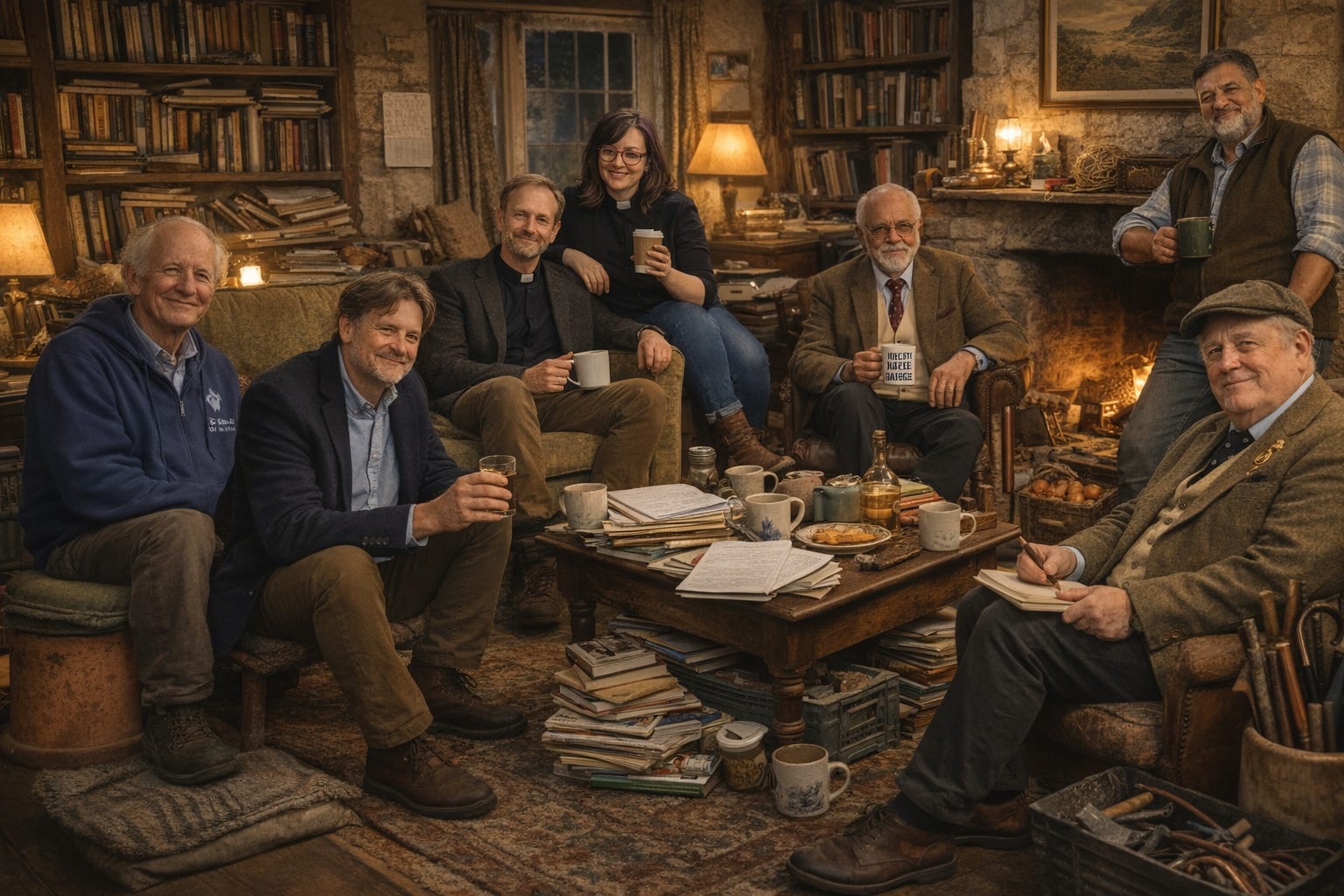
Thus fortified, they settled once more into the familiar arrangement. Tim on the sofa. Sandy on the arm of it. Lionel upright, this week holding a mug advertising a steam rally in Dorset, which he regarded as tolerable. Perry on the folding stool, notebook ready. Abe nearest the books. Kevin at the edge of the hearthrug on the three-legged milking stool. Horse against the mantelpiece, preserving his customary posture of principled semi-participation. Leslie, serene as ever, upon the flower-pot.
It was Perry who began.
“Well,” he said, with the dangerous brightness of a man who had thought about this in advance, “miracles.”
Horse closed his eyes briefly. “There goes the evening.”
Tim smiled. “Come now. It was your threat about putting the kettle off if anyone raised the dead before seven-thirty that really set the tone.”
“It was not a threat,” said Horse. “It was a boundary.”
Abe took a sip of tea. “All right, then. Let’s start plainly. What do believers think a miracle is? A suspension of the laws of nature? A divine intervention? A statistically unusual event with better publicity?”
“That,” said Kevin, “is very nearly three different questions.”
“Yes,” said Abe. “I know. It’s my gift.”
Lionel adjusted his grip on the steam rally mug. “The trouble with miracles is that Christians often speak as though the options were either crude supernaturalism or embarrassed silence. Neither is satisfactory.”
Sandy grinned. “That sounded exactly like you.”
“Good,” said Lionel.
Tim leaned forward. “Perhaps the first thing to say is that Christians have not historically meant just one thing by miracle. Sometimes they mean a remarkable event taken as a sign of divine action. Sometimes they mean a healing. Sometimes a biblical wonder story. Sometimes simply an encounter with grace so profound that the ordinary word fails.”
“Yes,” said Abe, “but that is part of the problem. The more sensible believers become, the more elastic the word gets. Before long, a miracle is either the feeding of the five thousand or finding your car keys.”
Perry glanced up. “Surely no one says that.”
